The poor getting squeezed out of public healthcare facilities
Public Healthcare Inequality In Bangladesh: Poor people’s access to public healthcare is shrinking, with wealthier groups increasingly receiving a greater share of benefits from government facilities, a government study has found.
Poor people’s access to public healthcare is shrinking, with wealthier groups increasingly receiving a greater share of benefits from government facilities, a government study has found.
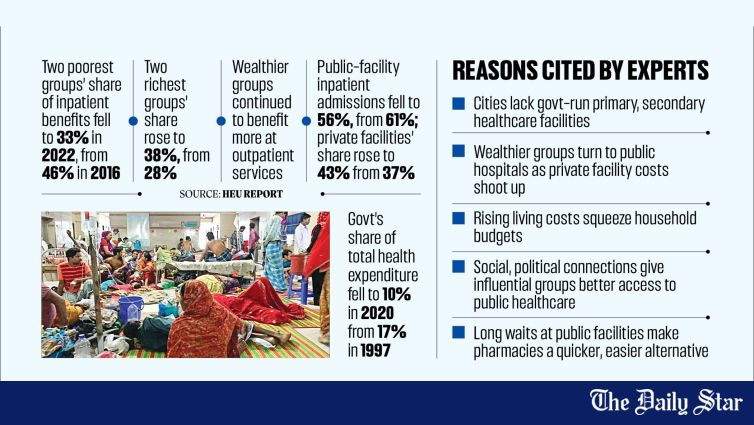
Inpatient services at public facilities have shifted from favouring poorer people to benefiting wealthier groups over six years, while outpatient services have continued to disproportionately benefit the rich, according to the study by the Health Economics Unit (HEU) under the health ministry.
In 2016, the poorest two of five wealth groups received 46 percent of the benefits from inpatient services at public facilities, compared with 28 percent for the richest two groups.
By 2022, the pattern had reversed: the poorest two groups received 33 percent of the benefits, while the richest two received 38 percent.
The disparity in outpatient services remained largely unchanged. In 2016, the poorest two groups received 35 percent of the benefits from public outpatient services, compared with 45 percent for the richest two groups. In 2022, their respective shares stood at 37 percent and 44 percent.
The HEU conducted the study with support from the World Health Organization (WHO) and the Swedish Embassy. It analysed four rounds of the Household Income and Expenditure Survey (HIES), conducted in 2005, 2010, 2016 and 2022, to examine trends in healthcare spending, its impact on poverty and inequalities in access to publicly funded health services.
In HIES, rather than assigning fixed taka thresholds, researchers rank the entire surveyed population from lowest to highest based on household income, consumption expenditure, or an asset-based wealth index, and divide them into five equal groups of 20 percent each.